
How You Doing

All last year when I said “how you doing?” to anyone I felt chagrin for asking such a stupid question, but not enough to not ask it, not enough to not inquire, because this is what we do as human beings, check in on each other. It’s like saying “good morning” to someone in the morning, especially at work, when you first see them. I spent so many mornings in kitchens when no one acknowledged one another like that, only the day’s tasks, like we were headed into war. Service loves to think it is akin to battle, the language, the pace, the temperament, proximity to greatness and self-involvement. Saying good morning, asking about one another, that’s not our downfall. Here we are, in the war, and we need to acknowledge one another.
But how are you doing? On this fascist train during an ongoing genocide? In this economy? What an idiot, and then I’d answer “I’m fine but the world is hell,” and the person generally agreed. So far 2026 feels like a no-bid contract our former mayor, Eric Adams, set up for his buddy who runs some company. Why must we always improve, why can’t the upcoming year offer us something, other than some new Pantone cloud white ‘color’?1
“We had whistles. They had guns.” I can’t get these words from Becca Good out of my mind, they’re from her statement about her wife Renee Nicole Good who was murdered point blank by that fucking ICE agent who looks like that wasn’t his first casual kill. These words, even as they reverberate in my brain, do not represent her beautiful statement about Good, but they are the facts of the day. Maybe my fixation on them is a bit cynical, but I won’t do their work for them. More so than cynical, I am stubborn. People, we are stubborn. Our cynicism becomes their power, and I’m not interested in helping anyone this greedy get more. The whistles do beat the guns, for the very fact that there will be more whistles. Don’t mistake me for a pacifist, or one of those who think we’re bringing the violence on ourselves when we show up to exact our rights. We’ve been living in violence for a long time now, whether you’ve been touched by it or not. Now, more of us can see it.
Presently I am depressed, isolated, overwhelmed by the world, underwhelmed by me, and underemployed, a crappy cocktail. Last I checked, this is called January. I try to turn it around by making stock, helping my friends out, and reading the Hélène Cixous interview in the new Paris Review. Reading returns me to my earliest version of myself, and to do so without the internet helps.2
I don’t have a big year end list. I’m not one for lists, although I do love the cadence of words in that format. I read more in 2025, beyond the usual thrillers I reach for, which I love, still love! I am both inspired and sometimes daunted by the community here to challenge myself and become a better writer. Here are a few impactful books I read in 2025.
Everything for Everyone: An Oral History of the New York Commune, 2051-2072 by M.E. O’Brien and Eman Abdelhabi.
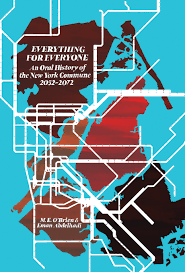
I heard co-author Eman Abdelhabi at the Jewish Voices for Peace conference on the Fight to Win: Organizing for Material Change and to Transform Our Conditions panel in Baltimore last spring, I bought this there because I figured I would forget about it. My friend did the cover, Josh MacPhee, an incredible artist and activist who is a part of the Interference Archive and Justseeds artist collective. Josh is one of those people that when he’s in the room, I know I’m in the right place. This book is the shit, a vision of the future after a revolution in New York City, an oral history of how this change happened and what present life (in 2072) looks like from a collection of interviews. And wow, what a fucking vision of an equitable future, an anarchist life. We’re scared of so much right now, everything is terrifying, and unsure. The future isn’t promised. In a best case scenario we end up somewhere here.
Care and Feeding by Laurie Woolever.
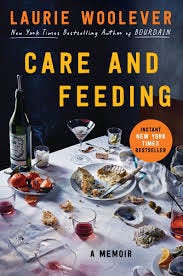
Laurie Woolever is a friend, and I’ve wondered what her memoir would be about since I found out she was writing it. Assistant to Mario Batali from 1999 to 2002, then assistant and ultimately lieutenant to Anthony Bourdain for almost a decade, up until his death. This could easily be a compilation of salacious tales through experience and proximity, and yes that’s some of that, but these aren’t just cocktail party stories. Woolever captures coming to New York with more dreams than resources, and the jagged little pathways to getting somewhere. The excerpt published by Grub Street before her book came out stands alone as example and answer to anyone who asks “why would you do that? why would you work there?” while answering those questions, whether you like the answers or not. She comes to terms with herself, her personal fucking being, both the one decided by society and the one she felt available to her and she becomes who the fuck she actually is. Her writing proves that.
There’s Always This Year: On Basketball and Ascension by Hanif Abduraqqib
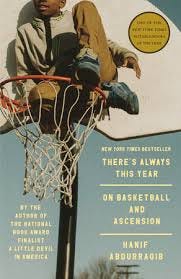
One of my favorite writers, but I never read him quickly. In his last book, A Little Devil in America: In Praise of Black Performance, his writing, the poetry, and cultural criticism, felt more integrated, and this book, about basketball, being a fan, being a person, family, faith, furthers Abduraqqib’s style. Sometimes I don’t know what I am reading, not in a formalist sense, but just in terms of feelings. Some texts make me realize how I have quarantined myself from emotion, from mine. This is one of them. Just an incredible book.
Aftermath : Life in the Fallout of the Third Reich, 1945-1955
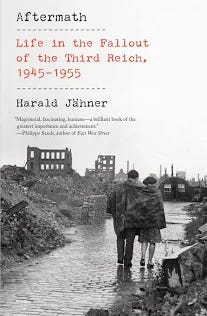
If I went back to school it would be for political science. Or I’d be a spy. God, I’d be a great spy. This book, about Germany for the decade after World War II, from the moment when they looked at the world and said “look what happened to us!” And the world looked back and said “look at what you did!” to the last bit of rubble being cleared from Dresden in the 1970s. We could be headed for another world war, but maybe those things are more about the world a century ago. When my friend asked why I was reading this, I thought about how wars change borders, change the world. How this was the start of the Cold War, and I’m still trying to find the book where the discussion between the Allies and the Soviet Union on how they decided to not only split up Germany East and West but also Berlin, is documented. I have to be careful to not become History Channel/Anything Nazi dad, but I think this history is still breathing, and as someone who studied Russian and Russian History and spent a little time in the Soviet Union, I’m fascinated by this beast.
The Picnic: A Dream for Freedom and the Collapse of the Iron Curtain by Matthew Longo
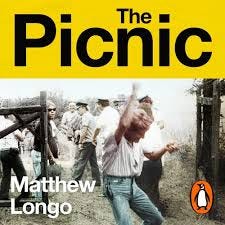
Another Eastern Bloc historical hit, my local library is delivering. A picnic where maybe 700? perhaps 1000?3 people defected from communist Hungary to Austria, considered the first brick coming out of the Berlin Wall. An incredible convergence of people and happenings under the Iron Curtain4 that gives me hope.
Tell me more about this year without telling me that some cloud white color is the color of the year.
I saw Helene Cixous speak once, with Jacques Derrida, at the Northwestern campus in 1995, after I graduated from college and moved to Chicago. A flier was posted in a coffeeshop on the far north side of Chicago where I lived. I drove from my job at an office in a record distributor to Evanston, no small feat during rush hour. Cixous and Derrida spoke about the civil war in Algeria, that started in January 1992 and ended in February 2002, about being Algerian and Jewish and living in France and being outsiders.
Shouldn’t this be real FOMO? That we don’t actually know how many people defected that day?
A phrase I haven’t heard in so long that for a moment I couldn’t believe it was real. No nuance. No chill.
I recently discovered that I can read books on my phone, downloaded from... various sources... even if I didn't love the tiny screen. Fixed this by getting a cheap old ipad mini which barely connects to anything but isn't so old I can't (with difficulty) sync my books app which means I now have the ability & freedom to read books in a way I really haven't since I was in high school. (There's also an ancient kindle paperwhite that awaits the right cord so I can attempt to jailbreak it. Why buy something functional when you could just give yourself more projects, forever?)
Mad with power, I have been downloading books like I need to save a library. Once I get my head out of the necessary scifi escapism (Anne Lecker was very fun, Adrian Tchaikovsky not bad), I've got Everything for Everyone up at the top of the list. "Readers who like Octavia Butler, Ursula LeGuin, Kim Stanley Robinson, Ian M. Banks, Samuel Delaney, and China Mieville"?? Hell yeah sign me up.
So much to discuss that doesn't belong in comments.
DAMN, this book list! I am in love. I acquired Everything for Everyone at Pilsen Community Books a couple of years ago and have given it away/rebought it at least three times. It is *totally* the shit and seems to freak some people out a little, which I love.